
Architecture
Data Flow
Section titled “Data Flow”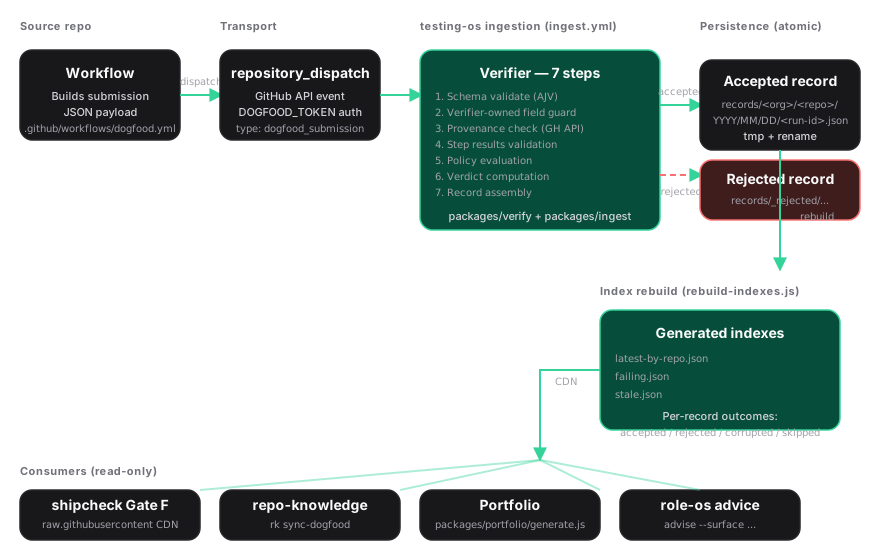
The same flow as text (terminal-friendly fallback for screen readers and CLI viewers):
Source repo workflow  → Builds structured submission (JSON)  → Emits via repository_dispatch to testing-os
testing-os ingestion pipeline  → Schema validation (AJV)  → Provenance check (GitHub API)  → Policy evaluation (enforcement, scenarios, freshness)  → Verdict computation (source proposes; verifier confirms    or downgrades)
  → Accepted: records/<org>/<repo>/YYYY/MM/DD/<run-id>.json  → Rejected: records/_rejected/<org>/<repo>/YYYY/MM/DD/...
  → Index rebuild:      indexes/latest-by-repo.json      indexes/failing.json      indexes/stale.json
Key Design Decisions
Section titled “Key Design Decisions”Central Ingestion
Section titled “Central Ingestion”Source repos never write records directly. They emit structured payloads via repository_dispatch, and only the testing-os bot writes to the records directory. This prevents source repos from fabricating evidence.
Verdict Ownership
Section titled “Verdict Ownership”The source repo proposes a verdict (overall_verdict in the submission). The verifier can confirm or downgrade — never upgrade. A source claiming “pass” that fails schema or policy validation becomes “fail.”
Sharded Persistence
Section titled “Sharded Persistence”Records are stored at records/<org>/<repo>/YYYY/MM/DD/<run-id>.json. This provides natural time-sharding, easy browsing, and clean git history without merge conflicts.
Generated Indexes
Section titled “Generated Indexes”latest-by-repo.json is rebuilt from accepted records after every ingestion. Consumers read indexes, not the raw record tree. This keeps reads fast without scanning git history.
Components
Section titled “Components”| Component | Location | Purpose |
|---|---|---|
| Verifier | packages/verify/ |
Schema, provenance, policy, verdict validation |
| Ingestion | packages/ingest/ |
Pipeline orchestration, atomic persistence, index rebuild |
| Submission builder | packages/report/ |
Canonical submission assembly for source repos |
| Portfolio | packages/portfolio/ |
Org-level summary generation |
Verifier Pipeline (8 steps)
Section titled “Verifier Pipeline (8 steps)”The verifier (packages/verify/index.js) processes each submission through eight stages in order:
- Repo-binding cross-field guard – runs first, before schema validation: rejects a submission whose
submission.repodoes not match the owner/repo encoded insource.run_url(validators/repo-binding.js). Without it, a submitter could claimsubmission.repo = "victim-org/victim-repo"while supplying arun_urlfor a real run from their own repo – provenance would confirm the run exists and persistence would file the forged “pass” under the victim’s path. This is a first-class trust-boundary stage with its own parser module and provider-lockstep CI test, not part of step 2’s schema check. - Schema validation – validates the submission against
dogfood-record-submission.schema.jsonusing AJV. - Verifier-owned field guard – rejects submissions that include fields only the verifier may set (
policy_version,verification, oroverall_verdictas an object). - Provenance check – confirms the source workflow run actually exists via the GitHub Actions API (or a stub adapter in tests).
- Step results validation – checks that each scenario’s required steps have matching results and that verdicts are internally consistent.
- Policy evaluation – evaluates enforcement tier, required scenarios, freshness, and execution-mode constraints from the repo or global policy. When a policy names required scenarios, their definitions are supplied by the ingestion layer, which for a
githubsubmission performs a read-only fetch of the submitting repo’sdogfood/scenarios/<scenario_id>.yamlat the attested commit (size-capped and schema-validated; an absent file leaves required-steps enforcement off with a visiblerequired_steps unenforcedwarning). This read and the provenance check are the pipeline’s two routine calls to the GitHub API – the same surface disclosed in the README security section and the Error Code Reference. - Verdict computation – computes the final verdict. The source proposes a verdict string; the verifier may confirm or downgrade, never upgrade. Verdict severity from highest to lowest: fail, blocked, partial, pass.
- Record assembly – builds the persisted record with verifier-owned fields (
verification.status,verification.verified_at,overall_verdict.verified,overall_verdict.downgraded).
Generated Indexes
Section titled “Generated Indexes”The index generator (packages/ingest/rebuild-indexes.js) produces three files after every ingestion:
| Index | Content |
|---|---|
indexes/latest-by-repo.json |
Latest accepted record per repo and surface – the primary read model for consumers |
indexes/failing.json |
Records where the verified verdict is not pass |
indexes/stale.json |
Repo/surface pairs with no accepted record within the staleness threshold (default 30 days) |
Atomic Persistence
Section titled “Atomic Persistence”Records are written atomically: the persist layer writes to a temporary file, then renames it to the final path. Duplicate detection by run_id prevents double-writes (collisions surface as DUPLICATE_RUN_ID — see Error Code Reference). Accepted records go to records/<org>/<repo>/YYYY/MM/DD/, rejected records to records/_rejected/<org>/<repo>/YYYY/MM/DD/.
Rebuild Outcomes
Section titled “Rebuild Outcomes”packages/ingest/rebuild-indexes.js returns four arrays per call: accepted, rejected, corrupted, skipped.
accepted/rejected— record loaded cleanly; routed byverification.status.corrupted—JSON.parsefailed on the file. The rebuild logs[rebuild-indexes] corrupted record skipped: <path> — <error>to stderr and continues; the record is excluded from all indexes.skipped— record loaded but missingrun_id.
Corruption does not fail the rebuild — the index is silently incomplete until repaired. See Operating Guide → Corrupted Record Recovery for the procedure.
Enforcement Tiers
Section titled “Enforcement Tiers”| Mode | Behavior | Default |
|---|---|---|
required |
Blocks on violation | Yes – all repos start here |
warn-only |
Warns but doesn’t block | Must have documented reason |
exempt |
Skips evaluation entirely | Must have documented reason + review date |
Missing policy defaults to required – the safe default.